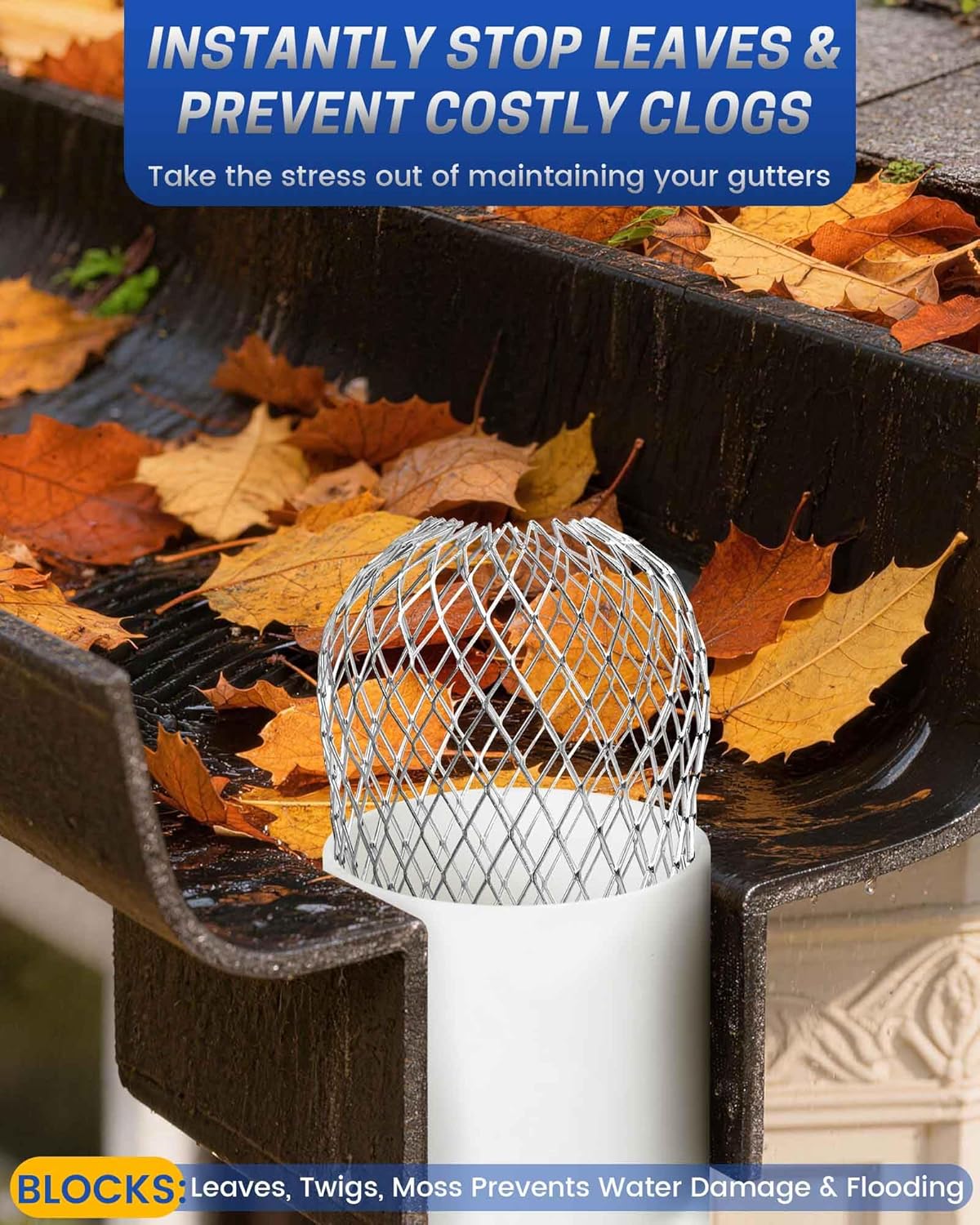
Your gutter — the long trough that runs along your roofline — collects rainwater and routes it into a downspout, which is the vertical pipe that carries water down to the ground and away from your foundation. At the top of that downspout, where the trough meets the pipe opening, sits one of the most overlooked parts in the entire drainage system: a downspout strainer (also called a downspout guard or outlet strainer). It’s typically a small dome- or basket-shaped screen, usually made of wire or plastic, that sits inside the gutter outlet and blocks leaves, twigs, and debris from funneling into the pipe below. If that pipe clogs — and it will, eventually, without protection — you’re looking at water backing up behind fascia boards, pooling against your foundation, or overflowing in exactly the wrong spots. Per Angi’s 2025 cost data, professional downspout flushing and clog removal runs $150–$500 per service call depending on severity and access. The strainer that might have prevented it retails for $4–$18. This article walks you through every format, material, and sizing decision so you pick the right one the first time.
Why the Outlet Is Your System’s Weak Link
If you’ve been in this field for a year or two, you already know that most gutter failures aren’t structural — they’re maintenance failures that compound. The downspout outlet is where that compounding starts. Here’s the physics: debris that enters a gutter trough tends to migrate toward the lowest point, which is always the outlet. Add any standing water — from a slightly off-pitch run, an undersized outlet, or a partial blockage — and you create the ideal environment for organic material to compress into a dense plug. That plug doesn’t just slow drainage; it creates back-pressure that can lift gutter sections, accelerate rust at seams, and force water behind the fascia (the board your gutter hangs from) where it silently rots framing.
Fine Homebuilding’s coverage of residential gutter systems notes that downspout outlets are disproportionately responsible for system-wide backups because they represent the single highest-velocity, highest-concentration point in the entire water path. Everything the gutter collects has to pass through a 2×3-inch or 3×4-inch opening. Even a modest leaf load can bridge that opening within a single storm season without a strainer in place.
The counterintuitive part: a strainer doesn’t eliminate maintenance. It changes the location of debris accumulation from inside a buried pipe (expensive, hard to access) to the top of the strainer dome (visible, cleanable in 30 seconds). That’s the actual value proposition. You’re not avoiding the debris; you’re keeping it somewhere you can deal with it.
Format Comparison: Dome vs. Basket vs. Flat-Screen
Three physical formats dominate the market, and the choice between them has real consequences for flow rate, debris load, and cleaning frequency.
Dome strainers (also called balloon guards or spherical strainers) are formed-wire hemispheres that drop into the outlet and sit proud of the gutter floor. Their geometry is the key advantage: because the dome sits above the outlet, debris rests on top of the dome rather than sealing flat across the opening. Water still passes around the sides and through the wire. In heavy-debris environments — overhanging hardwoods, pine needle loads — dome strainers consistently outperform flat alternatives because partial coverage doesn’t kill flow rate. Bob Vila’s comparative buyer’s guide on gutter guards notes that dome-style outlet strainers are the most widely installed format in professional residential work for exactly this reason. They’re also the easiest to pull and rinse during a gutter cleaning visit.
Basket strainers are cylindrical cages, usually 4–6 inches tall, that drop into the outlet like a cup. They hold more debris volume before clogging than a dome (more surface area) and are particularly well-suited to 3×4-inch downspout openings where the larger footprint can actually fit. The tradeoff: they sit deeper in the gutter, which means they can reduce effective gutter depth near the outlet — a real issue on shallow-profile gutters or any run with marginal pitch.
Flat-screen inserts are the lowest-cost option ($4–$8 typically) — a simple stamped-metal or plastic disc that presses into the outlet opening. They work adequately in low-debris environments but are the format most likely to seal flat under leaf load, creating the very blockage they were meant to prevent. Family Handyman’s gutter maintenance coverage flags flat-screen inserts as acceptable for pine-needle-only environments (needles don’t bridge flat screens the way broad leaves do) but explicitly warns against them as a primary solution under deciduous canopy.
By the Numbers
| Format | Typical Price Range | Best Use Case | Main Weakness |
|---|---|---|---|
| Dome / balloon strainer | $6–$14 | Mixed debris, most residential runs | Must fit outlet diameter precisely |
| Basket / cage strainer | $8–$18 | High-volume debris, 3×4” outlets | Reduces usable gutter depth |
| Flat-screen insert | $4–$8 | Pine needles, minimal leaf load | Seals flat under broad-leaf debris |
Material Decisions: Galvanized, Stainless, Plastic, and Copper
Material is where a lot of practitioners leave money on the table — in both directions.
Galvanized steel (zinc-coated carbon steel) is the industry default for good reason: it’s rigid, holds its dome shape under debris weight, and costs $6–$10 in most standard sizes. Its weakness is longevity. In humid climates or anywhere standing water is common (which, by definition, includes any under-performing gutter), galvanized strainers show rust-through within 3–7 years. That rust staining runs down the downspout and onto whatever surface sits below — a real problem on painted or stucco exteriors. For most production installs and remodeler work, galvanized is appropriate if you’re pairing it with a regular cleaning schedule.
Stainless steel runs $10–$18 and represents a straightforward upgrade for anyone specifying a system they don’t want to touch for a decade. Owners and contractors who’ve made the switch report no corrosion issues even in coastal and high-humidity applications. For aluminum seamless systems in the $300–$800 installed range, the $4–$8 premium over galvanized is noise. For copper systems — where a rust streak from a galvanized strainer sitting in a copper gutter is genuinely embarrassing — stainless is the minimum acceptable spec.
Copper strainers are available through specialty distributors and are the correct choice for copper half-round gutter systems (Revere Copper, Gibraltar Building Products, and similar). The galvanic compatibility argument is often overstated for a small wire dome sitting at low contact area, but the aesthetic argument is not: a copper gutter outlet is visible from certain sight lines, and a green-oxidizing copper dome reads as intentional detail rather than an afterthought. Expect to pay $15–$35 per strainer through copper gutter specialty suppliers. This Old House’s coverage of copper gutter systems notes that hardware selection — including outlet strainers — should match the primary metal to avoid both aesthetic inconsistency and any potential electrolytic interaction over long time horizons.
Plastic (usually PVC or ABS) strainers are the format you’ll find in big-box vinyl gutter starter kits. They’re adequate for light-duty applications and won’t rust, but they become brittle in UV exposure and tend to crack within 3–5 years in sun-exposed outlets. For any install you’re putting your name on, plastic strainers are a liability. Use them only when they’re already included in a packaged vinyl system and the homeowner’s timeline is short.
Sizing: The One Spec That Determines Everything Else
Every other decision is secondary to getting the diameter right. Standard residential downspout outlets come in three common footprints:
- 2×3 inches — the most common outlet size in older residential and budget vinyl systems. Dome strainers for this size are widely stocked at lumber yards and gutter supply houses.
- 3×4 inches — standard for most professional aluminum seamless installs today, offering meaningfully better flow capacity. Basket strainers fit this size particularly well.
- Round outlets (3-inch and 4-inch) — common on half-round gutter systems, copper installations, and commercial work. These require round-profile dome or cage strainers; rectangular strainers will not seat correctly.
Measuring is straightforward: pull the existing strainer if one is present (or measure the outlet opening at the bottom of the gutter channel) and match the strainer’s seating diameter to the outlet. A strainer that’s even a quarter-inch undersized will shift and unseat during debris accumulation; oversized strainers won’t drop into the outlet at all. When you’re spec’ing a system rather than buying a single unit, get the outlet dimensions from the gutter profile manufacturer before ordering strainers in bulk. Spectra Metal Sales and similar seamless-system suppliers typically include outlet dimensions in their product documentation.
Installation and the Cleaning Interval Question
Installation is genuinely a drop-in operation — no tools required for dome and basket formats. The strainer seats into the outlet and gravity plus debris load holds it in place. The only exception is some round copper outlets that use a press-fit basket secured with a small screw; that’s a two-minute operation but requires a screwdriver and knowing it’s the right format before you start.
The harder question for practitioners is what cleaning interval to recommend or build into a maintenance contract. A strainer doesn’t reduce how often you need to access the gutter; it just makes the cleaning faster and prevents the expensive emergency call. A general rule that holds across most residential environments: inspect strainers at every gutter cleaning visit and pull-and-rinse after every significant debris event (ice storms, heavy leaf fall, construction work nearby). In a single-story suburban home with moderate tree canopy, that’s typically twice a year. In heavy-canopy environments — mature oaks or maples within 20 feet of the roofline — quarterly inspection is defensible.
Fine Homebuilding’s gutter systems coverage recommends treating strainer maintenance as a trigger-based protocol rather than a fixed calendar: check after any storm that deposits visible debris in the gutters, not just seasonally.
The Decision Rule
If you’re configuring or specifying right now, here’s the straight line through the options:
- If it’s a copper or high-end architectural system: copper or stainless dome strainer, round profile if half-round gutters, full stop. The $20 per outlet is a rounding error on a $3,000–$6,000 install and the alternative is a rust stain on a showpiece.
- If it’s a professional aluminum seamless system (3×4” outlet): stainless steel basket or dome strainer. Galvanized is acceptable budget-wise, but stainless eliminates a future callback.
- If it’s a production residential install or remodel with standard 2×3” outlets: galvanized dome strainer is the appropriate workhorse spec. Upgrade to stainless if the homeowner is in a coastal or consistently humid climate.
- If it’s a vinyl DIY or starter kit: use the included plastic strainer for now, plan to replace it with a galvanized or stainless dome within 2–3 years.
- If debris load is extreme (hardwood canopy, roof valleys funneling debris to a single outlet): specify a basket strainer over a dome at that outlet for higher debris-holding capacity, and flag it for more frequent inspection.
The $10 strainer doesn’t eliminate every gutter maintenance conversation — but it moves the failure point from an inaccessible buried pipe to a visible, cleanable dome you can clear in under a minute. That’s the trade every system deserves.