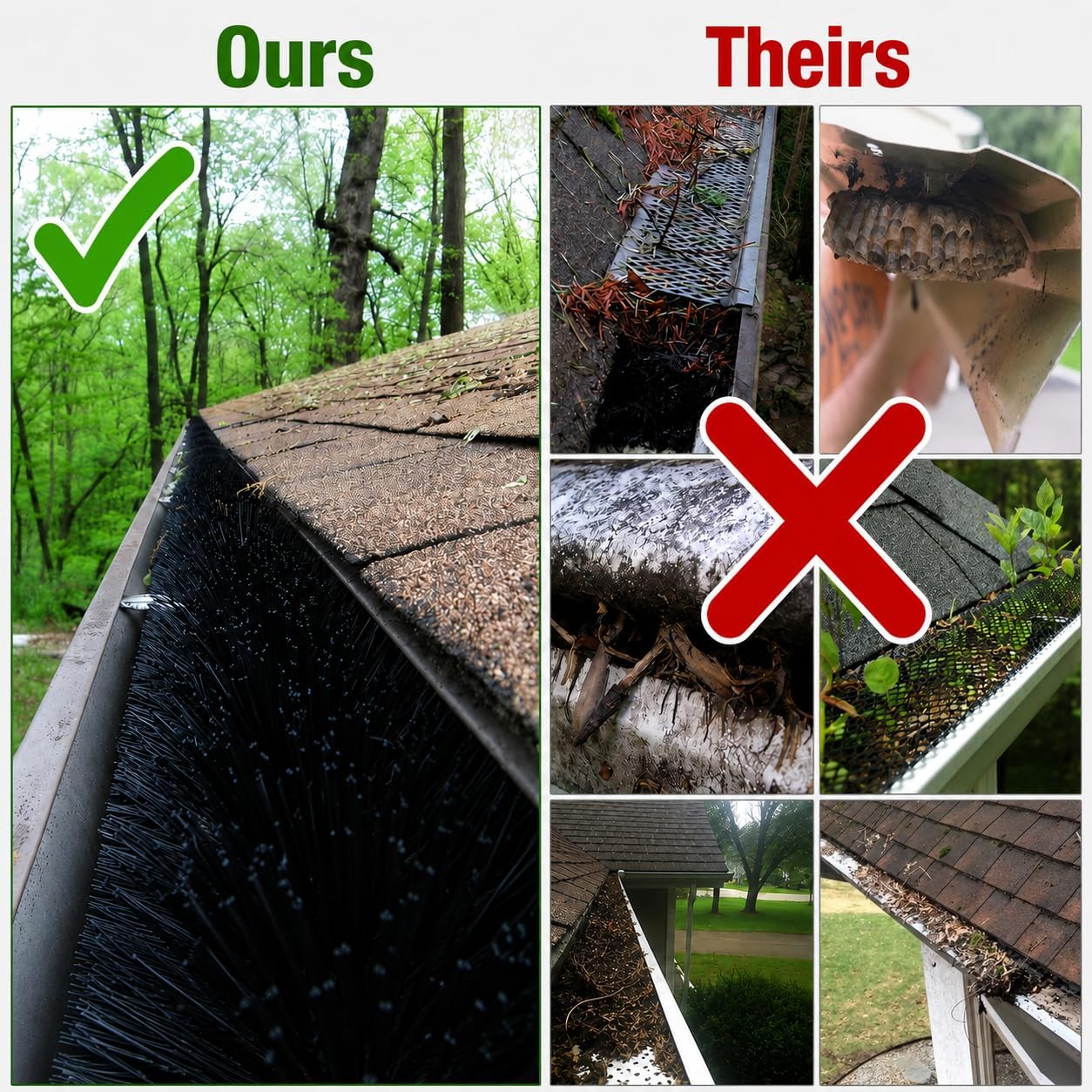
You’ve got a gutter full of pine needles every November, and someone at the hardware store just told you that a $30 foam insert — a wedge of open-cell polyurethane foam that sits inside your gutter channel and supposedly lets water through while stopping debris — will solve the whole problem. The pitch is seductive: no tools, no ladder time past the initial install, no contractor invoice. Before you load 100 feet of the stuff into a cart, though, it’s worth sitting with the actual tradeoff math. Foam and brush inserts (brush guards look like a giant pipe cleaner running the length of your gutter) are real products with a legitimate use case — but that use case is narrower than the packaging implies, and the failure mode is expensive and messy in a way that a $30 price tag disguises.
This article breaks down exactly what foam and brush guards do well, where they collapse under real-world conditions, how they compare head-to-head on the numbers, and the decision rule you need before committing to a full-run installation.
| EDITOR'S PICK[GutterBrush Gutter Guard for 5…](https://www.amazon.com/dp/B09GW8Z364?tag=greenflower20-20) | Mid-tier[Pro Gutter Guard - 5-Inch K Sty…](https://www.amazon.com/dp/B003H9LXQQ?tag=greenflower20-20) | Budget pick[A-M Gutter Guard – Premium Heav…](https://www.amazon.com/dp/B083S1HKD4?tag=greenflower20-20) | |
|---|---|---|---|
| Type | Brush | Foam | Aluminum |
| Compatibility | 5 in gutters | 5 in K-style | 5 in & 6 in gutters |
| Material | Brush | Foam | Aluminum |
| Length | 60 ft total (DIY) | — | 7 in (sample) |
| Made in USA | ✓ | — | ✓ |
| Price | $189.00 | $131.99 | $2.79 |
| See on Amazon → | See on Amazon → | See on Amazon → |
What You’re Actually Buying: How Foam and Brush Inserts Work
Both product types share the same core theory: fill the gutter with a porous material, and debris sits on top while water filters through. The execution differs.
Foam inserts are triangular or wedge-shaped lengths of open-cell polyurethane or polyether foam, typically 3–4 feet per section, designed to fit snugly inside a K-style or half-round gutter channel. Water is supposed to wick through the foam’s cell structure and drain into the downspout. Debris — leaves, needles, seed pods — rests on the surface and either blows off or breaks down over time.
Brush inserts (sometimes called bristle guards) are cylindrical polypropylene bristle assemblies, resembling an oversized bottle brush, that sit on the gutter floor. The bristles create a physical barrier that catches large debris while leaving gaps for water flow. Brands like Gardener’s Supply and GutterBrush have made this format mainstream.
Both types install without tools, require no fasteners, and are sold by the linear foot at most big-box retailers. That simplicity is real and genuinely valuable in the right context. The problem is that simplicity is also where the risk lives.
The Honest Performance Picture: What Owners Report Across Conditions
This Old House’s editorial review of gutter guard types notes that foam and brush inserts consistently receive the lowest long-term satisfaction scores among homeowners with significant tree canopy — specifically deciduous trees dropping large quantities of wet, decomposing leaf matter. The pattern in aggregated owner reviews is consistent and worth naming explicitly:
What works: Owners in low-debris environments — properties with minimal tree overhang, primarily large-leaf deciduous trees (maple, oak), and dry climates where debris stays loose — report that foam and brush guards reduce gutter-cleaning frequency meaningfully in the first 1–2 seasons. Family Handyman’s overview of gutter guard types echoes this: for homeowners whose primary nuisance is occasional leaves rather than continuous pine needle or shingle-grit accumulation, these inserts can genuinely extend the service interval.
What fails: The failure mode is almost always the same, and it’s documented across consumer reviews cited by Bob Vila’s gutter guard roundup: fine debris — pine needles, maple seeds (samaras), shingle granules, cottonwood fluff — works into the foam or bristle matrix rather than sitting on top of it. Once embedded, this material doesn’t blow out. It compacts, retains moisture, and within 2–4 seasons becomes a growth medium for moss, mildew, and in some cases root systems from germinated seeds. The gutter now needs to be cleaned and the insert removed, cleaned or replaced, and reinstalled — a multi-step job that costs more time and money than skipping the insert entirely.
Consumer Reports’ guidance on gutter guards flags this directly: foam-type inserts may accelerate organic growth inside the gutter channel because the moist, porous material creates ideal conditions for biological buildup that a clean aluminum or vinyl gutter surface would not.
By the Numbers
| Product Type | Installed Cost (100 ft) | Expected Service Interval (low debris) | Expected Service Interval (high debris) | Replacement Frequency |
|---|---|---|---|---|
| Foam inserts | $150–$280 DIY | 18–24 months | 6–12 months | Every 3–5 years |
| Brush inserts | $180–$350 DIY | 18–24 months | 6–12 months | Every 4–6 years |
| Micro-mesh (aluminum) | $400–$900 DIY | 36–60 months | 24–36 months | 10–20 years |
Cost estimates per Angi’s 2025 gutter guard cost guide; service intervals reflect aggregated owner-reported patterns across published reviews.
The math here is the decision. If you’re in a high-debris environment and replace foam inserts every 4 years — plus one professional cleaning per replacement cycle at $150–$300 — your 10-year total cost for 100 feet approaches $600–$1,000. A mid-grade micro-mesh system installed once in that same window costs $400–$900 and likely requires only one or two professional cleanings. The foam option’s cost advantage evaporates.
Where Foam and Brush Guards Actually Win
Practitioners who dismiss these products entirely are overcorrecting. There are three scenarios where foam or brush inserts are the defensible choice:
1. Short-tenure properties. If you’re managing a rental property or flip where you need to present clean, functional gutters for 12–24 months without a capital outlay on a permanent system, foam inserts are a legitimate bridge product. They’re faster to install than any fastened guard system, require no structural modification, and are invisible from the street. The degradation timeline works in your favor here — you’re out before it becomes a problem.
2. Single-nuisance debris profiles. Properties with one or two large deciduous trees dropping big, flat leaves that dry quickly perform dramatically better with foam and brush guards than properties under conifers or heavy seed producers. If your only gutter enemy is autumn oak leaves and your gutters are otherwise clean, the insert math may actually hold over a 5-year window.
3. Gutters that are difficult or expensive to access. On a two-story structure with complex rooflines where every professional cleaning quote starts at $400+, reducing cleaning frequency from annually to every 2–3 years has real dollar value even if the inserts eventually need replacement. The reduced access risk — fewer ladder climbs, fewer contractor visits — is a legitimate safety and cost argument.
The Tradeoffs Practitioners Miss: Compatibility and Voiding Coverage
Two issues consistently catch intermediate buyers off guard.
Gutter warranty implications. Most aluminum and vinyl seamless gutter systems carry manufacturer warranties on the gutter channel itself — typically 10–20 years on the material. Some manufacturers explicitly state in warranty documentation that third-party inserts that retain moisture against the gutter wall can void coverage for corrosion or deformation claims. Before installing foam inserts in a relatively new gutter system, pull the warranty card or manufacturer spec sheet and read the exclusions. This is especially relevant if you’re specifying for a client whose gutters are still under warranty from a recent installation.
Half-round gutter incompatibility. Foam and brush inserts are engineered for K-style gutter profiles. K-style gutters have a flat bottom and back wall that gives the insert a stable seat. Half-round gutters — common on craftsman, colonial revival, and high-end contemporary exteriors, and the standard profile for copper systems — have a curved bottom that foam wedges cannot conform to. Attempting to retrofit K-style foam into a half-round channel leaves gaps along the edges that defeat the insert’s purpose entirely. If any portion of your project involves half-round profiles, foam and brush options are off the table.
UV degradation on foam. Polyurethane foam exposed to direct sunlight and temperature cycling degrades faster than manufacturer timelines suggest in hot-climate installations. Owners in USDA hardiness zones 9–10 (the Southwest, Florida, coastal California) report foam inserts becoming brittle and crumbling within 2–3 seasons — significantly below the 5–7 year replacement interval often printed on packaging. Bob Vila’s testing roundup notes this as a consistent regional limitation.
Comparing Against the Next Tier: When to Step Up
The natural upgrade from foam or brush inserts is an aluminum micro-mesh guard — a product category that uses a fine stainless-steel or aluminum mesh membrane bonded to an aluminum frame that snaps or screws onto the gutter lip. Products in this category include Gutterglove Pro, LeafFilter’s mesh-based residential line, and MasterShield’s pitch-matched design.
The operational difference is fundamental: micro-mesh keeps debris on the surface of the guard, where it can dry and blow off or be brushed away, rather than absorbing and trapping it inside the gutter channel. This is why Consumer Reports and This Old House consistently rank micro-mesh as the highest-performing category for year-round, multi-debris-type environments.
The honest practitioner’s frame: if the project is more than 80 linear feet, involves any conifer or heavy seed-tree canopy, or is specified for a client who will not tolerate any maintenance follow-up, foam and brush inserts are the wrong tool regardless of budget pressure. The cost difference between a foam install and a mid-grade micro-mesh install — roughly $250–$600 for 100 feet — is recoverable in avoided cleaning costs within 4–6 years in a high-debris environment.
The Decision Rule
Here’s the if/then frame that covers the majority of real-world scenarios:
-
If debris load is low (few trees, large leaves, dry climate) AND budget is constrained AND the property has a horizon of 3 years or less → foam or brush inserts are defensible. Buy by the linear foot, install yourself, plan to re-evaluate at the 2-year mark.
-
If debris load is moderate to high (conifers, maples, cottonwood, heavy seed drop) OR the property is a long-term hold → step up to aluminum micro-mesh. The foam savings are a first-year illusion; the 5-year math doesn’t support them.
-
If the gutter profile is half-round → foam and brush inserts are incompatible. Full stop.
-
If the gutter is under manufacturer warranty → read the exclusions before installing any insert. Document the warranty terms for your client file.
-
If you’re specifying for a client → the liability framing matters. An insert that fails and causes a gutter overflow event that damages fascia or foundation landscaping is a conversation you don’t want to have. For client work, the micro-mesh tier is the defensible minimum.
Foam and brush guards are not scams — they’re niche tools that the retail channel oversells into universal-solution positioning. Know the niche, match the product to it, and the math works. Ignore the niche, and you’re buying yourself a cleaning problem with extra steps.