If you’ve just signed a contract on a Victorian or Craftsman restoration — or you’re specifying gutters for a new custom build where the architect specifically called out half-round profiles — you already know the basic vocabulary. You know that half-round gutters are the semicircular troughs (shaped like a pipe cut lengthwise) that were standard on American homes before the 1950s, when the cheaper-to-manufacture K-style (the ogee-profile channel you see on virtually every tract home today) took over. What you may still be sorting out is the decision stack beneath that shape choice: which hanger system, which leaf-guard product, and whether to commit to copper — a material that changes color over years and decades — or to use a more stable aluminum alternative that mimics the profile at a fraction of the cost. That’s the decision this article is built to settle.
Why the Hanger System Is the First Spec Decision, Not the Last
Most practitioners price the gutter material, then think about hangers as an afterthought. That’s the wrong sequence for half-round, because the hanger type dictates sight lines, labor cost, and long-term structural security in ways that don’t apply to K-style.
The three hanger families and their tradeoffs:
Spike-and-ferrule (legacy): A long aluminum spike driven through the front face of the gutter, through a cylindrical spacer (ferrule), and into the fascia. This is what’s on almost every pre-1970s house you’ll encounter in restoration work. The problem is that the spike works itself loose over years of thermal expansion and contraction — owners of homes with the original spike system consistently report pulling the gutter away from the fascia and finding a row of oversized, corroded holes. If you’re matching a historic system purely for appearance and a future owner will re-spike it, fine; if you’re building a system that has to last 30 years, move on.
Hidden hanger (bracket): A stamped-metal clip that snaps inside the gutter and screws directly to the fascia. This is now the dominant system for K-style, but it was designed around the flat-bottom profile of that shape. Hidden hangers for half-round exist — several manufacturers make a round-bottom version — but the contact patch is smaller and torque resistance is lower. Per Fine Homebuilding’s guide to exterior drainage systems, hidden hangers work adequately for aluminum half-round in low-snow-load climates; contractors in zones with significant ice-dam exposure report premature pull-out at a higher rate than with fascia brackets.
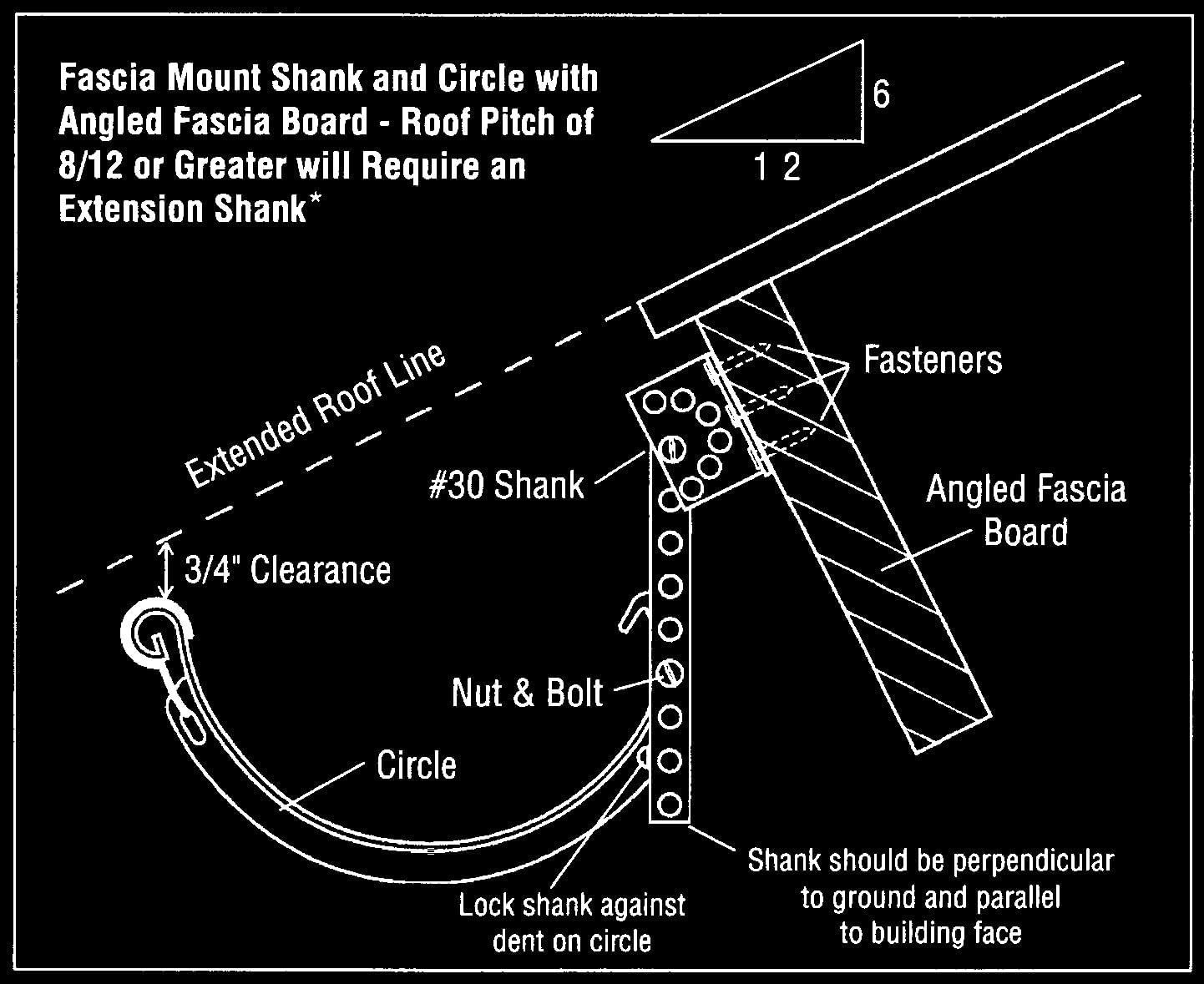
Fascia bracket (the right answer for most half-round installs): A visible strap or half-pipe bracket that wraps around the outside of the gutter and anchors into the fascia board. The bracket is exposed — you can see it — but on a period home or a high-design contemporary, a copper or painted steel bracket reads as intentional detail, not a shortcut. This Old House’s restoration guides consistently specify fascia brackets for copper half-round on historic properties, citing both load capacity and period authenticity. Spacing matters: 24 inches on center is the published standard, but in heavy-debris or high-snow regions, 18 inches on center adds meaningful pull-out resistance for a modest labor upcharge.
The math on hanger spacing:
- 5-inch half-round at 24” OC, 40-foot run: 21 brackets
- Same run at 18” OC: 27 brackets
- Delta at roughly $3–$6 per bracket installed: $18–$36 in material, 30 minutes of additional labor
- For a copper system already at $25–$40 per linear foot installed, this is a rounding error. Don’t skip it.
Leaf Guards for Half-Round: Where the Market Hasn’t Fully Caught Up
Here’s the honest version of the leaf-guard conversation for half-round gutters: the product market was built around K-style, and you’ll see that in every spec sheet if you read carefully.
The micro-mesh products — MasterShield, Gutterglove Pro, and LeafFilter are the three most-cited in contractor sourcing conversations — are engineered with a flat or slightly angled mounting flange designed to seat on K-style’s front lip and lay back toward the fascia. On a half-round profile, that geometry doesn’t exist. The gutter’s circular opening means a flat guard either bridges the gap (leaving a gap at the back where debris can enter) or requires a proprietary adapter.
What the spec sheets actually say:
Per MasterShield’s published installation documentation, their product is compatible with half-round profiles using a specific mounting bracket sold separately. Gutterglove Pro similarly notes half-round compatibility but specifies that the contractor must bend the mesh frame to follow the gutter’s curve — a step that adds installation time and, if done incorrectly, creates low spots where debris pools. LeafFilter’s published materials do not list half-round as a supported profile in their standard product line; installers sourcing LeafFilter for a half-round project should confirm compatibility in writing before signing a warranty.
The alternatives that actually fit the form:
-
Solid curved covers (surface-tension style): Products in this category use the physics of water surface tension — water clings to a curved surface and follows it into the gutter while debris falls off. The curved shape is a natural fit for half-round. The tradeoff is that surface-tension covers can overflow in very heavy rain events; contractors in the Pacific Northwest and Gulf Coast consistently flag this in long-run reviews.
-
Perforated aluminum inserts: A round-bottom perforated tray that sits inside the half-round gutter. These are inexpensive, period-correct in appearance, and effective against large debris. They are not effective against pine needles, maple helicopters, or fine shingle grit — the debris types that actually clog gutters in most markets.
-
Copper mesh roll: For copper half-round systems specifically, a loosely rolled copper mesh inserted into the gutter is a traditional solution that appears in Fine Homebuilding’s historic restoration case studies. It’s not a high-performance filtration system, but it’s maintenance-reducible (clear it every 1–2 years), aesthetically invisible from grade, and compatible with a copper system’s patina development.
Decision rule for guards on half-round: If the home has a large, overhanging tree canopy and the owner wants as close to zero-maintenance as possible, the honest recommendation is a compatible micro-mesh product with a verified half-round adapter — and a written warranty that specifies the profile. If the home is moderately treed and the owner will do annual maintenance, a copper mesh insert or a solid curved cover is cleaner, cheaper, and more period-appropriate.
The Copper Patina Question: Finance It Like the Material It Is
Copper half-round gutters are priced in a commodity market, and that’s not a figure of speech. The raw material cost is indexed to the COMEX copper spot price, which in May 2026 has been trading in the $4.20–$4.60 per pound range — roughly 30% higher than the five-year average prior to 2022. Published spec data from Revere Copper Products and Gibraltar Building Products puts standard 16-ounce copper sheet (the weight used in most residential gutter fabrication) at a significant premium over aluminum or galvanized steel.
By the numbers (May 2026 estimates, installed, full system including downspouts):
| Material | Profile | Installed cost per linear foot |
|---|---|---|
| Vinyl K-style | 5” | $6–$12 |
| Aluminum half-round | 5” | $12–$20 |
| Steel half-round | 5” | $15–$22 |
| Copper half-round | 5” | $28–$45 |
| Copper half-round | 6” | $35–$55 |
Sources: Angi cost data, contractor sourcing reports, Revere Copper published price schedules. Ranges reflect regional labor variation.
The patina question isn’t just aesthetic — it’s financial. Copper oxidizes through a predictable sequence: bright penny-orange at installation, darkening to a brown-black within 12–24 months, and developing the classic blue-green verdigris (the formal name for that oxidation layer) over 10–30 years depending on rainfall acidity and regional climate. Coastal and urban environments accelerate the process; dry inland climates slow it.
The case for letting it go green: The patina is a protective oxide layer, not damage. Per Gibraltar Building Products’ technical documentation, properly installed copper gutters with natural patina development can exceed 100-year service life with no coating maintenance. From a total-cost-of-ownership standpoint, amortized over that lifespan, copper’s premium over aluminum compresses substantially. On a historic property where the exterior finish is already copper (standing-seam roof, copper flashing), matching patina color is a legitimate design specification — not a luxury indulgence.
The case for stabilizing the finish: Some design-forward contemporary projects want the copper material but not the color variability — they want to lock the finish at bright or at brown-black. Clear lacquer coatings exist for this purpose and are available from several metal finishing suppliers. Bob Vila’s exterior materials guide notes that lacquered copper requires reapplication every 5–10 years as UV and thermal cycling break down the coating, and that an imperfect recoat can create blotchy areas where uneven patina develops beneath the clear layer. If finish consistency matters more than low maintenance, the honest tradeoff analysis favors a pre-patinated or factory-finished aluminum product that mimics aged copper rather than the real thing maintained under lacquer.
The aluminum alternative honestly appraised: Several manufacturers now offer aluminum half-round in “aged copper” powder-coat finishes. Per published spec sheets from suppliers including Spectra Metal Sales, these products match copper’s profile exactly, hold their finish for a manufacturer-rated 20–25 years, and install at roughly 40–50% of copper’s per-foot cost. They do not develop a living patina. On a genuine historic restoration where authenticity matters to a preservation board or a discerning owner, this is a meaningful difference. On a new custom build where the goal is visual harmony with warm-tone exterior materials, it’s a reasonable trade.
The Decision Frame
If you’re mid-negotiation on a spec, here’s the if/then structure that resolves most of these decisions:
If the home is a documented historic property or is being restored to period authenticity → specify copper half-round with fascia brackets at 18” OC, copper mesh insert for debris control, and a written disclosure to the owner about patina development timeline.
If the home is a new high-design build with warm exterior tones and the owner wants low maintenance → specify aluminum half-round in a powder-coat finish, fascia brackets, and a compatible micro-mesh guard with verified half-round adapter and written warranty.
If the home has a heavy tree canopy and the owner’s primary concern is maintenance reduction → solve the guard question first, because the right guard system may constrain your profile and material choice. Verify guard compatibility with half-round before committing to copper.
If budget is genuinely the constraint but the profile matters → aluminum half-round at $12–$20 per linear foot installed is a legitimate architectural choice, not a compromise. The profile reads correctly from grade. Put the savings toward fascia bracket spacing and a proper guard system.
The spec decisions on half-round systems are interdependent in ways that K-style work usually isn’t — hanger type affects guard compatibility, material affects patina expectations, and patina expectations affect owner satisfaction over a 10-30 year horizon. Getting them sequenced correctly at the contract stage is the difference between a system that delivers on its design promise and one that generates callbacks. The decision tree above isn’t complicated; it just has to happen before the material order, not after.