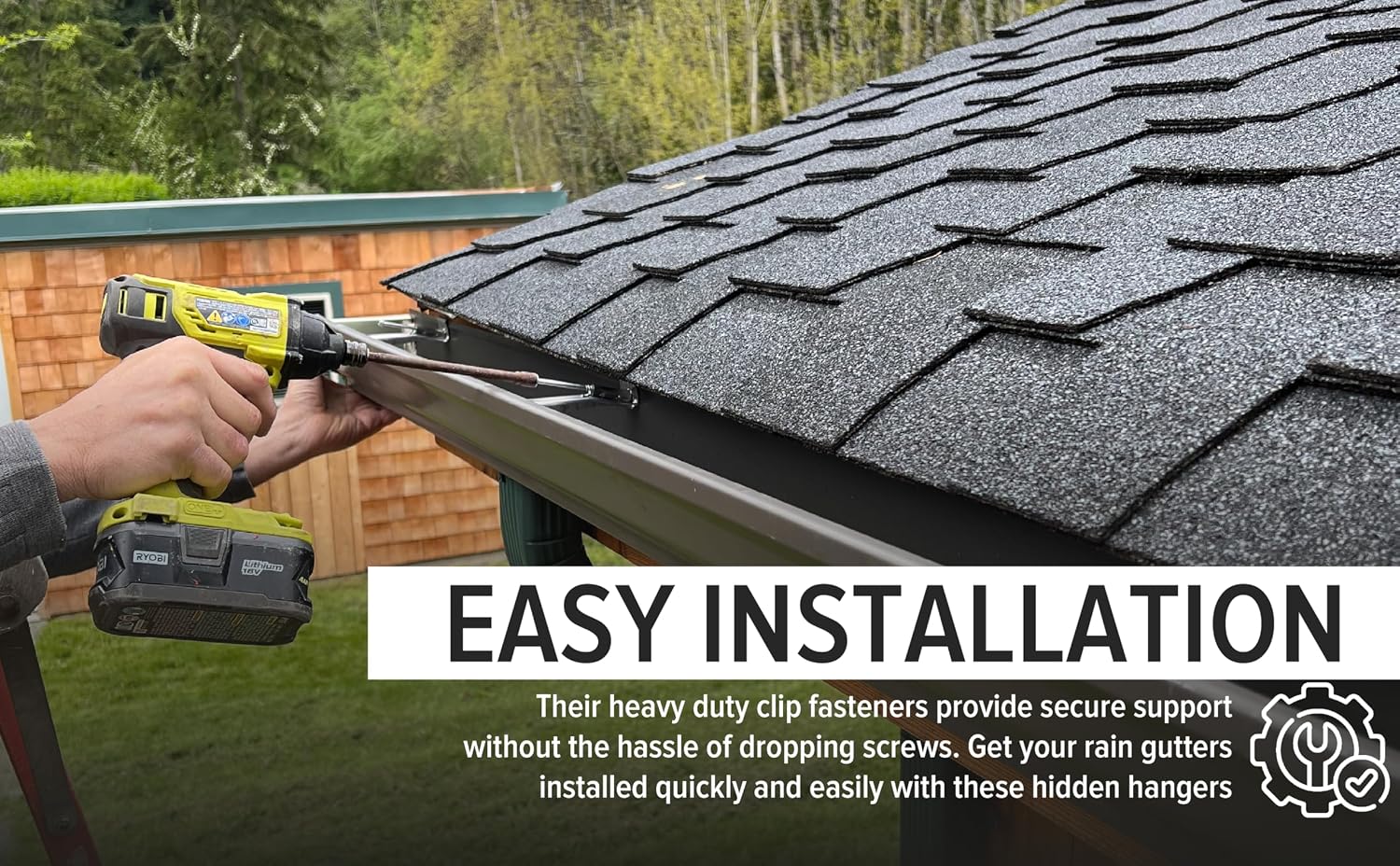
You did everything right choosing seamless aluminum gutters — researched the profiles, matched the finish to your fascia, maybe even spec’d a leaf-filtration system. Then someone handed you a bag of hidden hanger brackets and said “space them 24 inches apart,” and you nodded because it sounded reasonable. Here’s the uncomfortable truth: improper hanger spacing is the single most common reason a professionally installed gutter sags, pulls away from the fascia, or fails catastrophically during a 2-inch-per-hour rain event. A gutter hanger is simply the concealed bracket — hidden inside the gutter channel — that fastens the gutter to the fascia board (the flat board running along your roofline). Spacing is how far apart you place those brackets. Get both wrong and water overshoots the gutter, backs up behind the fascia, and rots the framing. This guide gives you the spacing math, the gauge specs that actually matter, and a clear decision framework for choosing hardware by climate and load.
| EDITOR'S PICK6” K Style Gutter Hangers Brack… | Mid-tier6 Inch Hidden Gutter Hangers fo… | Budget pick[Benfar 25Pack 5 Inch Gutter Han…](https://www.amazon.com/dp/B0CNGWZP3F?tag=greenflower20-20) | |
|---|---|---|---|
| Gauge | 0.615 | — | — |
| Size | 6" | 6" | 5" |
| Pack count | 250 | 25 | 25 |
| Price | $211.77 | $36.99 | $21.99 |
| See on Amazon → | See on Amazon → | See on Amazon → |
Why the “Every 24 Inches” Rule Is Only a Starting Point
The standard advice — one hanger every 24 inches — comes from the minimum requirement in many residential building codes and is echoed in general installation guides including the Family Handyman’s gutter installation walkthrough. It works fine in mild climates with moderate rainfall. But it’s a floor, not a ceiling, and treating it as the answer for every project is where practitioners get burned.
Three variables determine your actual required spacing:
1. Snow and ice load. A cubic foot of wet, packed snow weighs roughly 20 pounds. A 20-foot gutter run can easily accumulate 40–60 pounds of ice load in a freeze-thaw cycle. Fine Homebuilding’s coverage of cold-climate gutter installation recommends dropping to 16-inch spacing (matching stud spacing so every hanger hits a structural anchor) in USDA Plant Hardiness Zones 5 and colder — essentially any market that regularly sees sustained below-freezing temperatures.
2. Roof pitch and rainfall intensity. Steep-pitch roofs (7-in-12 or higher) deliver water to the gutter at higher velocity and volume. The National Roofing Contractors Association’s drainage best practices documentation notes that high-velocity discharge concentrates load stress at the gutter’s midspan — the weakest point between two hangers. On pitches of 8-in-12 or steeper, 16-inch spacing is strongly preferred even in mild climates.
3. Gutter width and gauge. A 6-inch K-style gutter holds more water weight than a 5-inch, but it also spans more unsupported distance between hangers. Heavier-gauge material (more on this below) resists deflection between hangers, which means you can extend spacing slightly — but thinner gauge demands tighter spacing to compensate.
The Spacing Math in Practice
Here’s a simple decision block for the jobs you’re likely quoting:
By the Numbers
- Mild climate, 5” gutter, standard pitch (≤6-in-12): 24” spacing
- Moderate climate or pitch 7–8-in-12: 18” spacing
- Cold climate (Zone 5+) or pitch >8-in-12: 16” spacing
- Any run over 40 feet: add one extra hanger at midspan regardless of zone
This Old House’s installation guidance confirms a comparable tiered approach, noting that in regions with significant snow accumulation, the 16-inch standard “provides meaningful insurance against midwinter sagging without meaningfully adding to labor cost.”
Gauge Specs: Where the Real Quality Divide Lives
This is where spec sheets separate commodity hardware from professional-grade product — and where a lot of intermediate installers get misled by surface appearances.
Hanger gauge refers to the thickness of the metal used in the bracket itself, measured by sheet-metal gauge standards (lower number = thicker metal). Most hidden hangers on the market are stamped from aluminum or galvanized steel. Here’s the landscape as of mid-2026:
26-gauge steel or .019” aluminum: Entry-level product. Fine for vinyl gutters in mild climates on short runs. The deflection tolerance under sustained load is low — meaning under heavy ice or water weight, these brackets flex noticeably before failure. This is the hardware in most big-box starter kits in the $0.30–$0.60/unit range.
.027” aluminum (the practitioner’s baseline): This is the sweet spot for most residential aluminum gutter work. It’s what the majority of professional gutter contractors spec as their standard install. The step up in stiffness over .019” is significant — roughly proportional to a 40% increase in load resistance before deflection. Spectra Metal Sales and comparable wholesale suppliers sell this tier, and it’s the spec you should be writing into your bids if you’re not already.
.032” aluminum or 24-gauge steel: Overkill for standard residential, genuinely appropriate for commercial applications, copper gutter systems, or any installation where the gutter doubles as a visible architectural element. Copper gutters — think Revere Copper or Gibraltar Building Products architectural-grade systems — have substantially more mass per foot than aluminum, and the hanger has to match. Per NRCA drainage documentation, copper gutter systems should use copper or stainless-steel hangers to avoid galvanic corrosion (the electrochemical reaction that occurs when dissimilar metals are in contact in the presence of moisture, causing accelerated deterioration of the weaker metal).
Screw length matters as much as gauge. A .032” hanger fastened with a 1.5-inch screw into 3/4-inch plywood fascia is weaker than a .019” hanger driven with a 2.5-inch #10 screw into structural lumber. Angi’s cost and installation guidance consistently flags fastener length as an underrated variable in hanger failure — and it’s something homeowners can’t easily evaluate after the fact without a ladder and a screwdriver.
Bracket Types: Hidden Hanger vs. Spike-and-Ferrule vs. Strap
You’re almost certainly using hidden hangers (also called snap-in or clip-style brackets) — the dominant professional standard since the early 2000s. But context matters when you’re advising clients or inheriting an existing gutter system.
Hidden hangers (the current standard): A single piece clips over the front lip and hooks the back of the gutter channel, then a screw drives through the hanger and into the fascia. They’re invisible from street level, they distribute load across the full gutter width, and they’re fast to install. This Old House and Fine Homebuilding both treat hidden hangers as the unambiguous default for new work. The tradeoff: they’re not retrofittable into spike-and-ferrule systems without removing the gutter.
Spike-and-ferrule (legacy): A long nail (the spike) driven through a metal tube (the ferrule) inside the gutter channel and into the fascia. Inexpensive and fast to install, but notorious for backing out over time as wood expands and contracts seasonally. If you’re repairing or re-securing an existing spike-and-ferrule system, the standard fix is to replace spikes with screws — same hole, longer-grip fastener, solved problem.
Strap hangers: Used primarily for half-round gutters (both historic and new-construction architectural applications). The strap wraps over the back of the round gutter and fastens to the roof deck or rafter tail rather than the fascia. If you’re speccing copper half-round work, strap hangers are the appropriate hardware — hidden hangers are designed around the K-style profile’s geometry and won’t interface correctly with a round-bottom channel.
Climate-Specific Decision Rules
Here’s the “if X, then Y” framework for the decisions you’re likely navigating right now:
If you’re bidding a standard residential aluminum 5” K-style in the Mid-Atlantic or Southeast (moderate rain, negligible snow): .027” aluminum hidden hangers at 24-inch spacing with 2.5-inch #10 stainless screws. This is the reliable professional baseline. Family Handyman’s installation guides consistently land here.
If the project is in New England, the Upper Midwest, or the Mountain West (heavy snow, freeze-thaw cycles): Upgrade to 16-inch spacing. Keep the .027” gauge, but verify screw penetration into structural lumber, not just fascia. If the fascia is composite or thin plywood, add backer blocks at every hanger location.
If you’re spec’ing a 6-inch gutter on a high-pitch roof (commercial residential, steep custom homes): Step up to .032” hangers, 16-inch spacing, and consider through-fascia screws into rafter tails. The load at the gutter’s back-wall attachment point on steep-pitch applications is meaningfully higher than standard residential work.
If the client has copper half-round gutters (Revere Copper, Gibraltar architectural grade): Strap hangers only, copper or stainless. Spacing at 24 inches is acceptable for standard runs; drop to 18 inches if the run exceeds 30 feet. Every dissimilar metal contact point is a corrosion risk — specify copper straps, copper screws, and copper downspout brackets throughout.
If you’re inheriting a spike-and-ferrule system and the client wants to extend its life without full replacement: Replace every third spike with a screw (not all of them — partial replacement avoids disturbing sealed joints). Flag in writing that this is a maintenance repair, not a full rehang, and include a clause limiting your liability for subsequent failure at untouched spike locations.
The Warranty Angle Nobody Reads
Most gutter manufacturer warranties — and this applies to major aluminum suppliers as well as copper product lines from Gibraltar and Revere — contain installation-method clauses that will void coverage if hanger spacing exceeds their published specification. Per NRCA guidance, this is a documented pattern: homeowners and contractors assume a product warranty covers the full installed system, but the fine print conditions coverage on compliance with the manufacturer’s installation manual.
Before you finalize your hanger spec on any job that involves a product warranty the client is counting on, pull the manufacturer’s installation document — not the sales sheet — and cross-reference the hanger spacing and gauge requirements. On premium copper systems, this documentation is typically available directly from Revere Copper Products and Gibraltar Building Products’ technical support lines. For commercial-grade leaf-filtration systems like LeafFilter or MasterShield, installation documentation often specifies minimum gutter rigidity requirements that functionally mandate tighter hanger spacing than the gutter alone would need.
Quick Reference: Spec Decision Table
| Scenario | Gauge | Spacing | Fastener |
|---|---|---|---|
| Standard residential aluminum, mild climate | .027” aluminum | 24” | 2.5” #10 stainless screw |
| Cold climate / heavy snow zone | .027” aluminum | 16” | 2.5–3” #10 into lumber |
| Steep pitch (>8-in-12) | .032” aluminum | 16” | 3” into rafter tail |
| Copper half-round, architectural | Copper strap | 18–24” | Copper screw |
| Commercial / leaf-guard system | .032” aluminum or steel | 16” | Per manufacturer spec |
The margin between a gutter installation that holds for 25 years and one that sags by year three isn’t the gutter itself — it’s 40 cents’ worth of hardware and 30 seconds of additional labor per hanger location. The math is never complicated once you’ve run it. The risk is assuming the default is always the right answer.